1. Introduction
Digital Audio Broadcasting (DAB) technology achieves multi-program transmission within a single frequency point and Single Frequency Network (SFN) configuration through Coded Orthogonal Frequency Division Multiplexing (COFDM) modulation and multiplexing mechanisms, significantly enhancing spectral efficiency and coverage quality. In the DAB transmission chain, the ETI (Ensemble Transport Interface) stream serves as the standard baseband interface between the multiplexer and transmitter, carrying multiple audio channels, data services, and synchronization information. It is a core technical element ensuring DAB network interoperability and equipment compatibility. This article focuses on the technical definition, core applications, and professional testing solutions of ETI streams.
2. Technical Definition
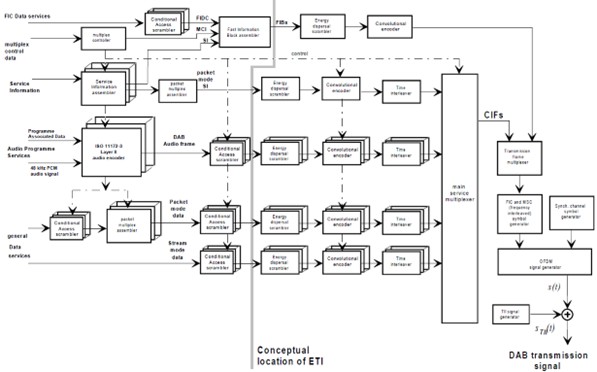
ETI is the standard baseband interface between the multiplexer and transmitter in Digital Audio Broadcasting (DAB) systems, defined by the ETSI EN 300 799 technical specification. As the core data carrier in the DAB signal distribution link, it adopts a fixed 24-millisecond frame structure. Each frame contains the Fast Information Channel (FIC) and Main Service Channel (MSC): the FIC transmits multiplex configuration information, service lists, conditional access control information, and label text without time interleaving to ensure rapid receiver lock; the MSC carries audio subchannels and data service content, supporting time interleaving to resist multipath fading. ETI completely encapsulates multiple program contents and SFN synchronization timestamps, enabling transparent transmission from the service layer to the physical layer. Its core technical parameters include G.704 frame alignment and microsecond-level synchronization precision. The bit rate adapts to the upper limits of mainstream transmission link physical rates such as G.703/G.704/V.11 and dynamically adjusts with the number of subchannels and service data volume, forming the cornerstone of DAB network interoperability.
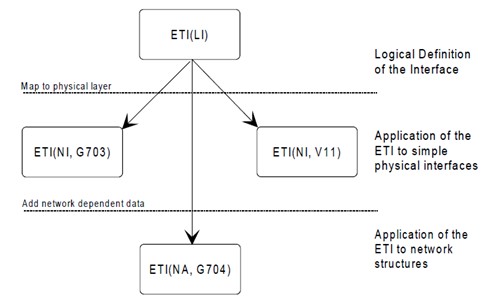
Although the ETI stream is the core carrier for services and synchronization information in the DAB transmission link, and its standardized encapsulation ensures network interoperability, there remain differentiated requirements in various test scenarios: R&D phase precision testing (such as single subchannel index traceability, abnormal scenario reproduction, and accurate fault location) requires more flexible parameter configuration and split verification capabilities; while production line batch verification and on-site rapid debugging scenarios focus more on efficient and convenient basic compliance testing. To address this demand difference, Doewe Technology provides a layered solution: for the R&D phase, the RWC2010C Broadcast Test System can be selected, which precisely adapts to high-precision debugging needs through detailed configuration and deep testing capabilities; for production line and on-site testing, the cost-effective RWC2010M Broadcast Integrated Tester efficiently completes equipment function and transmission compliance verification through convenient ETI file playback, multi-format signal transmission, and audio closed-loop verification, achieving multi-scenario test coverage.
3. Core Applications
1. Broadcast Equipment Functional Testing and Transmission Compliance Verification
ETI streams are used to test equipment protocol consistency and parameter compliance of transmitters, multiplexers, and other devices. Broadcasters use standard ETI test files to verify key functions such as stream parsing, FIC decoding, and subchannel extraction in the transmission link, ensuring equipment implementation complies with ETS 300 401 standards and reducing receiver incompatibility risks.
2. Receiver Device Compatibility Verification
ETI streams are core tools for receiver manufacturers to ensure global product compatibility. By playing standard test signals, they verify minimum functional requirements such as subchannel selection, FIC parsing, and dynamic reconfiguration response, confirming products meet European and global DAB network interoperability specifications.
3. Signal Generation, Recording, and Quality Analysis
Use signal generators to produce ETI streams that simulate weak signal, multipath interference, and SFN networking test scenarios; use portable stream recording analyzers to capture over-the-air DAB signals and save them as ETI files, enabling on-site problem reproduction and offline indexing analysis to support network optimization and fault diagnosis.
4. Core Equipment: RWC2010C/M
ETI stream testing requirements vary by scenario. Doewe Technology's RWC2010x series provides corresponding solutions. For detailed R&D testing, the RWC2010C offers a professional and more powerful option; for production line batch verification, the RWC2010M provides a cost-effective alternative.
4.1 Functional Overview
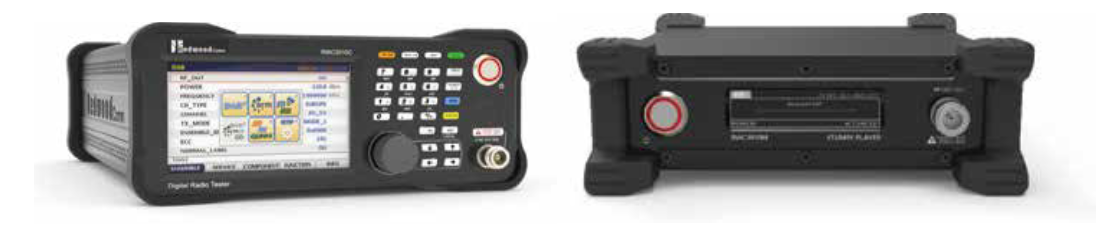
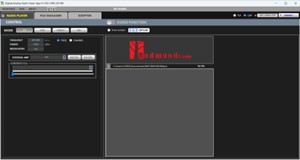
The RWC2010x series integrates core capabilities of ETI/MDI file playback, multi-format signal transmission, and audio analysis. It can fully reproduce recorded ETI files from broadcast DAB signals, accurately restoring signals containing multiple audio channels, data services, and synchronization information, meeting diverse testing needs from basic compliance verification to deep technical debugging. Among them, the RWC2010C focuses on high precision and multi-function expansion for the R&D phase, while the RWC2010M focuses on efficient and convenient scenario-based testing. Together they cover multi-dimensional testing of broadcast equipment.
4.2 Product Differentiation Features
RWC2010C(R&D/Complex Scenario Adaptation)
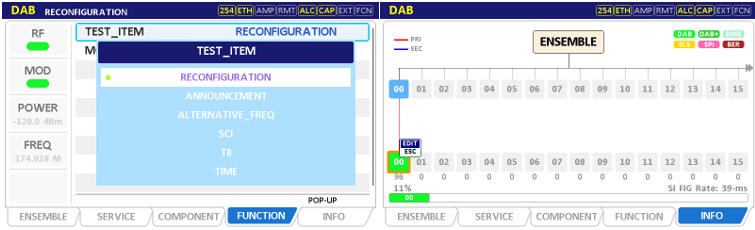
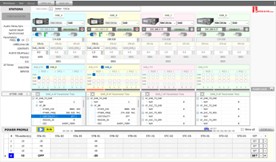
In-depth Debugging Capability: Built-in integrated multiplexer supports editing of 64 DAB service components and 4 DRM streams. Protocol parameters can be conveniently configured through the GUI interface to achieve uninterrupted-service multiplexing reconfiguration, frequency switching, and other high-tech protocol testing, adapting to single subchannel index traceability requirements.
Complex Network Expansion: Supports linking 4 devices to build a Single Frequency Network (SFN) test environment, with adjustable signal delay resolution down to 0.1μs. Also compatible with RWC2100F equipment to achieve seamless switching testing of multi-format services including DAB, DRM, and FM.
Multi-function Enhanced Configuration: Equipped with a 5-inch color touch LCD screen for more intuitive operation; can simultaneously generate 3 FM/RDS signals with a built-in dedicated RDS editor to meet deep R&D testing needs for multi-format integration and complex scenario simulation.
RWC2010M(Production Line Preferred)
Portable Standalone Operation: Dimensions only 200×70×220mm, weight 2.2kg, supports 12V DC power supply, equipped with 2.8-inch OLED display. Parameter viewing and on-site debugging can be completed without external PC, adapting to outdoor and production line rapid operation scenarios.
Efficient Batch Testing: Standard LAN and RS232 remote interfaces support TCP/IP protocol and SCPI command set, can be easily integrated into automated test benches to achieve multi-device parallel testing, significantly improving production line verification efficiency.
Lightweight Precise Verification: Built-in audio analyzer supports SINAD/SNR/THDN measurement. 3.5mm stereo input interface can loop back receiver audio output to quickly complete quantitative evaluation of the full RF-to-audio chain, meeting basic compliance testing requirements.
4.3Performance Specifications
• Frequency Parameters: Low/Medium/High frequency bandwidth 149kHz~30MHz, Bands I/II/III cover 47~68MHz, 87~108MHz, 174~250MHz, frequency resolution 1kHz.
• Output Level: OFDM power output range -10~-120dBm (including guard band), resolution 0.1dB, accuracy ±1dB. With optional RWC9500B, supports +15~-55dBm (CW/OFDM).
• Audio Analysis: Input frequency range 0.1~20kHz, single-ended input 2.25Vrms, SINAD/SNR/THDN measurement, bandwidth 20kHz, Common Mode Rejection Ratio (CMRR) up to 56dB.
• Reference and Interfaces: Internal 10MHz frequency reference (stability 1.5ppm/year), supports external 10MHz reference input (0~+20dBm); equipped with Ethernet (RJ45), RS232 (D-sub9), 3.5mm stereo audio interface and N-type RF interface.
• Storage and Environment: Built-in 256G large-capacity memory, operating temperature adapted to 5~40℃; RWC2010C supports AC100~240V/50/60Hz power supply, RWC2010M supports DC12V/3A power supply, adapting to different scenario power requirements.
5. Conclusion
As the digital baseband core of the DAB system, ETI stream transmission quality directly affects the overall performance of broadcast networks. The RWC2010M efficiently supports production line and on-site ETI testing through hardware-level stream parsing and high-stable clock synchronization; the RWC2010C meets R&D-side precision verification needs with in-depth debugging and networking capabilities. Together they provide a precise and reliable professional platform for ETI testing, facilitating the development of digital broadcasting. For more technical details or product information, please visit Doewe Technology's official website (https://www.doewe.com) or call 010-64327909 to obtain detailed materials.