In R&D and production-line validation of smart terminals, in-vehicle infotainment, smart home products, and broadcast audio/video equipment, whether the audio plays as expected—clearly and stably—often determines user experience and functional reliability. Traditional approaches based on manual listening or a single sound card struggle to cover multi-channel, long-duration, high-volume verification, and they also fail to produce traceable, quantitative results. To address this, Doewe Technology proposes an engineering-ready audio assertion testing solution built on a high-precision data acquisition (DAQ) system and automated analysis software. Centered on synchronous acquisition plus algorithmic assertions, it forms an integrated closed loop of “acquire–analyze–decide–report,” significantly improving the efficiency, consistency, and reproducibility of audio testing.
The key to audio assertion testing is to convert “subjective listening impressions” into “objective metrics + executable pass/fail rules.” In typical audio verification scenarios, tests usually need to cover: audio present/absent detection; volume adjustment and stability checks; audio-quality anomaly assertions (noise, dropouts, bubbling/popping, abnormal sounds, etc.); frequency-component / sounding-frequency verification (FFT spectrum analysis or loop-count statistics); comparison with a golden reference (consistency of alarm/notification tones); audio duration statistics; and detection of unexpected volume jumps. Meanwhile, parallel verification across multiple speakers/microphones introduces requirements on channel count and synchrony. This solution supports parallel audio acquisition and assertion decisions at a scale of up to 32 channels.
In real projects, if audio testing relies only on oscilloscopes, sound cards, or standalone instruments, you often run into issues such as insufficient channel count; limited range and accuracy; difficulty guaranteeing synchronization; unstable triggering and long-duration recording; fragmented analysis tools; and cumbersome report generation. More importantly, manual listening and screenshot-based documentation cannot establish a unified judging criterion. As the number of prototypes increases or regression testing becomes frequent, both test cost and the risk of missed defects rise sharply. Therefore, an engineering solution is needed that is centered on a data acquisition system and is “scalable, multi-channel, and automatically judgeable.”
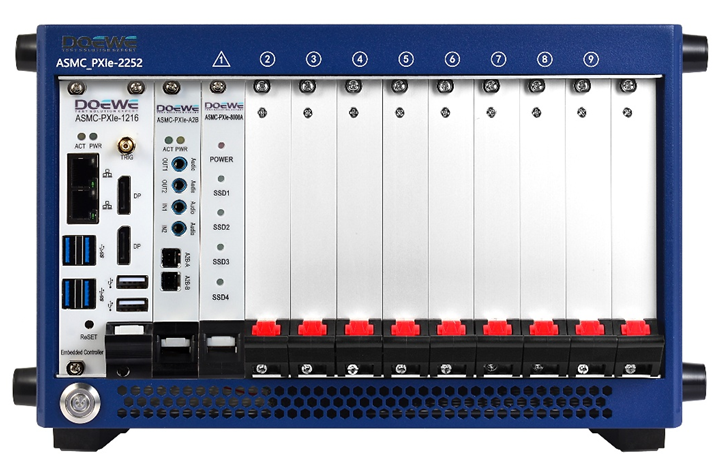
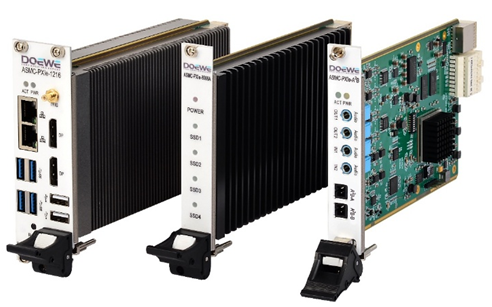
Doewe Technology’s audio assertion testing solution uses an integrated data acquisition host as both the acquisition and computing platform. With a built-in display and keyboard, the host can be flexibly configured with multiple high-precision acquisition cards to expand channel count. The system supports a typical sustained data storage throughput of 400 MB/s and can be configured with a dual-SSD storage architecture: a dedicated data drive for long-term recording and a system drive for the operating system and software, improving the reliability of continuous testing. The host features a 13-inch full-HD touch display, supports 10–36 V DC wide-range power input, and can be optionally equipped with a built-in UPS (about 5 minutes of continued operation after power loss) and an external battery power option (typically about 2 hours of continuous operation), enabling rapid deployment in both laboratory and field environments. Overall dimensions are approximately 318 × 253 × 128 mm; weight excluding the battery module is about 5.9 kg; and a single battery weighs about 540 g—balancing portability with engineering robustness. At the acquisition front end, the solution uses 24-bit multifunction analog-input acquisition cards to build 32-channel audio acquisition capability: per-channel sampling rates up to 200 kS/s; programmable single-ended/differential inputs; voltage ranges from ±30 mV to ±100 V; and support for IEPE (constant-current excitation) sensor interfaces to accommodate both line-level audio and sensors such as microphones/accelerometers. It also provides external trigger, camera trigger, and calibration ports, making it easy to implement an automated workflow of “event-triggered acquisition + witness-signal marking.”
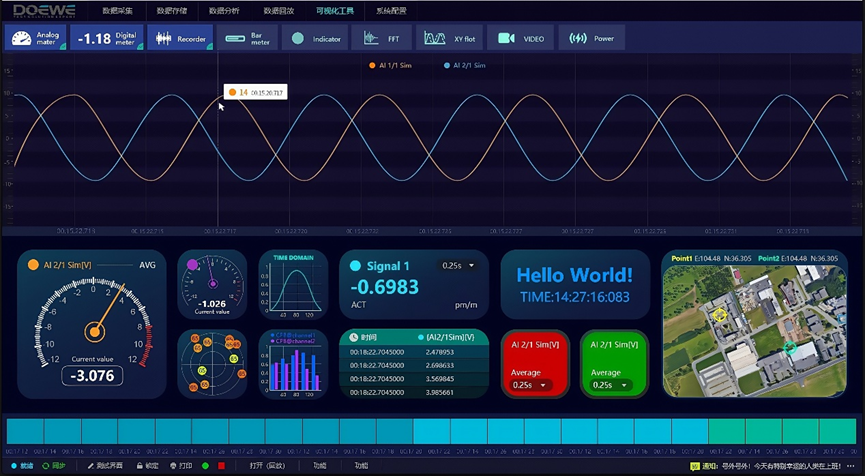
The accompanying automated test and analysis software provides a visual test interface and rich analysis tools. It allows you to assemble tools such as waveform recording, oscilloscope, FFT spectrum, spectrogram, and XY plots as needed. It supports storage strategies including triggered recording and automatic segmentation into multiple files, and lets you browse already-recorded data during live recording. The software includes powerful math and filtering modules that can perform statistics, formula calculations, and signal processing online/offline, and provides convenient report-generation tools for one-click output of conclusions and key plots. Meanwhile, the platform supports exporting data to common formats such as CSV, Excel, and MATLAB, and offers an open software development kit (SDK) to integrate with production-line test frameworks or in-house assertion algorithms. It supports remote control via SCPI and can synchronize multiple systems through local synchronization interfaces, GPS/IRIG, and other mechanisms, meeting the needs of expanded testing and collaborative measurements.
At the assertion-decision level, Doewe Technology typically achieves automated decisions by combining three categories of metrics—“envelope/energy, frequency-domain features, and template matching”:
1)Audio present/absent: based on energy/RMS thresholds and the duration of silence segments, determine whether a channel has valid audio output.
2)Volume check: extract peak, RMS, or loudness metrics to verify the volume adjustment trend and the steady-state fluctuation range, avoiding abrupt ups and downs.
3)Audio-quality anomaly assertion: combine features such as noise floor, burst impulses, short-time energy drops, and spectrogram streaks to identify noise, dropouts, popping/bubbling, abnormal sounds, etc.
4)Frequency analysis: use FFT or short-time Fourier transform (STFT) to extract fundamental frequency/harmonics/bandwidth features, or count the loop cycles of prompt tones, verifying that frequency characteristics meet expectations.
5)Audio comparison: compare the captured audio with a reference sample via correlation and spectral similarity to determine whether notification/alarm tones match.
6)Duration statistics: detect the audio start/end points and calculate playback duration to verify whether the audio length meets the design.
7)Volume-jump detection: analyze the rate of change of the audio envelope to assert whether unexpected jumps occur (suddenly louder/softer)
These metrics can be configured as “Pass/Fail” rules based on product specifications and process thresholds, and linked with trigger conditions, channel grouping, and batch scripts to enable stable, reproducible automated regression testing.
With 32-channel synchronous acquisition, the solution can simultaneously cover scenarios such as multi-speaker outputs, left/right channel consistency verification, array-microphone capture, and parallel stations for multiple products. Combined with triggering and long-duration recording, it can continuously monitor and preserve evidence for “hard-to-reproduce issues” such as intermittent abnormal sounds and occasional dropouts. In the R&D phase, it helps quickly locate problems in the audio chain and quantify improvement; in production-line and factory outgoing inspection, assertion rules can be solidified into standard workflows to produce traceable test records and reports, reduce missed-defect risk, and improve delivery consistency.
In summary, to meet multi-channel and high-volume verification needs, audio assertion testing must provide high-precision synchronous acquisition, stable long-duration recording, rich time- and frequency-domain analysis capabilities, and configurable automated decisions and report generation. Doewe Technology’s audio assertion testing solution built on a data acquisition system—powered by 24-bit, up to 200 kS/s multi-channel acquisition and an automated testing software platform—upgrades audio verification from “experience-based subjective judgment” to an engineering process that is “metric-driven, reproducible, and traceable.” It helps users significantly improve test efficiency and quality control, while reserving room for future large-scale deployment and system expansion.
Doewe Technology is committed to delivering innovative, differentiated, and reliable solutions in the data acquisition field. We understand that these elements are the foundation for companies to stay competitive. That is why we draw inspiration for innovation from real customer application needs, rather than simply showcasing flashy product features. By continuously optimizing and upgrading data acquisition solutions, Doewe Technology helps partners move toward a more efficient and precise future. Choose Doewe Technology—let’s open a new chapter in data acquisition together.